Showing posts with label inspiration. Show all posts

Sunday, 19 October 2014

Drawn to art

Gua Tewet, the tree of life, Borneo, Indonesia.
- an inspiration piece by  K. M. Lockwood


Human beings are compelled to create art. Some of our earliest surviving creations are paintings and to the best of my knowledge, every society has made marks that show recognisable beings. We are naturally visual - up to two thirds of our brain can be involved in processing what we see. So it's really not surprising that children love drawing - and pictures in books.

We give babies [quite rightly] books which are all images. Then as children age, the pictures give way to words. Sadly, it seems that in our culture, as the storytelling grows in difficulty, the illustrations diminish. I realise I am preaching to the converted, but I do wish there were more pictures in books for older children and young people everyone.

I wonder if this may be partly why boys often favour non-fiction: it's acceptable to have diagrams and charts and pictures if it's a fact book. Likewise, look at the appeal of joyously colourful comics, and the intensity found in graphic novels. People of all ages and stages are passionate about them.

V for Vendetta by Vendetta666 on Deviant Art

Here in SCBWI  we really know the complementary nature of Words and Pictures! But what can authors learn from artists? We already share a lot in terms of creativity - but what else can be learnt from the practice of drawing? Here are three thoughts:

  • life studies imply truly looking at the world. We don't have to go as far as Turner and lash ourselves to a mast to experience a storm at sea, but using our own viewpoint, not received wisdom, can deepen our understanding.
  • observation requires concentration. We need to pay attention to what lies beneath. What is the subtext of muscles below the skin of a conversation? Interactions have their own anatomy - and if we dissect real ones, we can create the imaginary.
  • sketch - accept that not everything you create will end up in the finished text. Allow some work to be scruffy, quick, unfinished. Let there be pieces from a point of view you will not use. Be experimental - and remember that all of it infuses the completed piece with depth. Nothing is wasted.
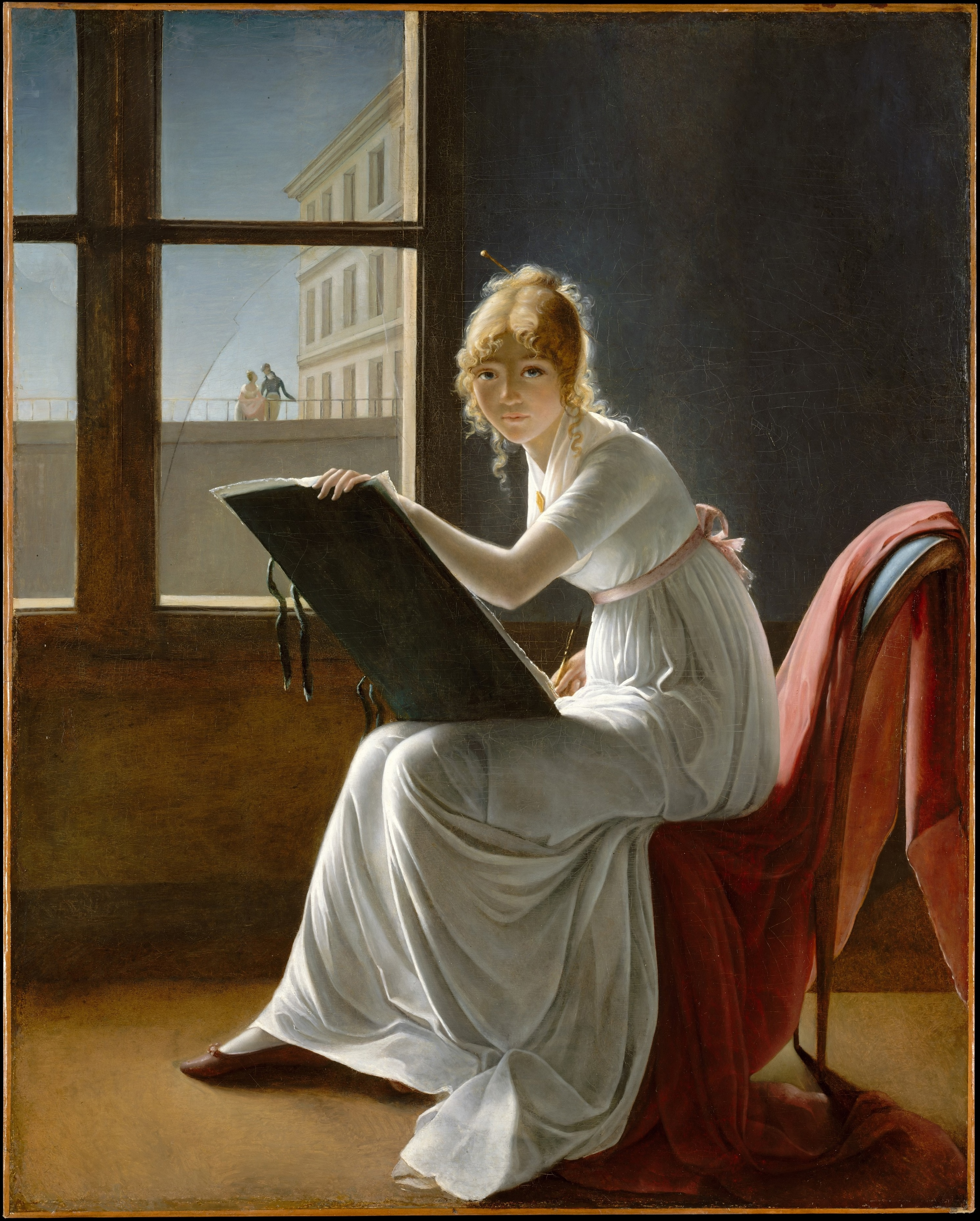
Young Woman Drawing, (1801, Metropolitan Museum of Art) painted by Marie-Denise Villers (possibly a self-portrait)

Suggestions
  • Go to an art gallery - many are free. You can always find a decent character or two - either in the portraits or in the viewers. 
  • Try moving a person in one painting to the setting in another. Is there a story in that?
  • If possible, watch an artist at work. If they don't mind, ask questions. Perhaps someone in your story world might paint or sketch.
  • Alternatively, doodle, colour in, gaze, trace - don't think about writing and be refreshed!
by  K. M. Lockwood - who posts on her blog from time to time,  often tweets from her garret, and writes and colours-in


Monday, 8 September 2014

Mixed Motives

An inspiration piece by K. M. Lockwood

Agatha Christie -
writer of 91 novels,
 not to mention the playscripts.


This month's theme is Motivation and Challenge. I want to break it down into the two parts to begin with, and against all alphabetical protocol, I'll go with Motivation first.


Motive for murder?
Motives are the driving forces that lead to action - as any detective writer knows. The word itself derives from the Latin movere - to move. Related words include [interestingly] emotion and motor. My mind jumps from there to motor skills - and muscle memory.

Bellydancer by Sean Thomas
As a belly dancer, I try to practise moves until they become automatic. I want my sinews and joints to remember how to taksim well, to follow a sequence of moves fluidly. I believe the same applies to writing, both figuratively and literally.

On one hand, practising, creating every day makes its own momentum. On the other, actually using the hands frees up many a creative person. Get marker pens, crayons, felt-tips, chalks - something physical to connect with your younger self. By-pass the cynical adult through motion.

Challenge

Hello. My name is Inigo Montoya.
 You killed my father. Prepare to die.
'Challenge' immediately summons up a duel in a misty forest at dawn for me. It has the sense of taking on something - it is the language of adversaries. I hear this a lot amongst rather fed-up creative people. Sometimes they mean an abstract concept - but often it is more personal.

Confronting  the Gatekeeper
 from Monty Python & the Holy Grail
We may see many obstacles blocking our way. It's tempting to feel you're outwitting an opponent, you're battling your way against others. It's a favourite storyline after all - the underdog who takes on the world and wins.

But I think this striving and pushing can be unhelpful. Seeing yourself always in opposition to someone else means you are not defining who you are. Like wet concrete inside shuttering - if the planks are removed, it oozes away into a lumpy mess.

Children on the beach at Kasai Rinkai Park
Listening to older and wiser people, I've learned two ways to avoid this. One: challenge only yourself to create better than you did before. Become your own judge. Two: partake in joyful competition. Think of dance-offs or racing to be the first in the water. Don't take it so seriously - mess about with friends. Challenge them with a lightness of heart.

Your two-part task
  1. Get a pen and paper, and a timer. In ten minutes, list as many motives for your writing or art as you can. Don't censor - just write. Leave in all the daft, the embarrassing, the pompous and downright weird reasons.
  2. Read them through. Consider which ones truly move you, and which belong to other people - be they real or your characters.
Child's Treasure Map of Brighton
by P. Fallows
Find your own drive. Explore your story world every day to find more wonders to seek after. Examine it with a magnifying glass, Mountaineer. Cave dive.  Let sharing the treasures you found there be the reason for talking about your work.

K.M.Lockwood is the writing name of Philippa R. Francis. She blogs quite often  from The Garret and gabbles away on Twitter as @lockwoodwriter.


Monday, 18 August 2014

Telling Tales

Abu Shady the last professional hakawati
or traditional storyteller in Syria 
In most cultures, the storyteller has an honoured place. Abu Shady here sits in the Al-Nawfara Coffee Shop Damascus. The reciter of Beowulf would have been given a warm spot by the fire. The whole horde in the great hall would fall silent when the first word 'Hwæt' was spoken and the well-known story 'held children from play'.


As the Anglo-Saxons knew, poetry helped people recite stories - through rhythm and alliteration, or rhyme. Movements and gesture, dance and other arts have all been used to convey the memory and wisdom of tribes through narrative. Engaging deeply with stories avoids the risk of that wisdom becoming trite, of becoming a stream of sound-bites only fit for tacky 'inspirational' posters. It is the shared going-through that embeds the sentiment in us - and the learning.

Kathak dancer - 'that which tells a story, that is 'Kathak'
Creative Commons
Story explores consequences. We learn their truths alongside our heroes and heroines, villains and tricksters, perplexed lovers and redeemed souls. A change of heart cannot be believed unless we truly know that heart and its many ways.

A burnt hand teaches best...
                                                     
                                                                                  it is said, yet when we truly live through a story, we share the learning without the worst of any pain or scarring. Storytellers, whether through words or pictures or both, invite their tribe to involve themselves in the drama. For our readers or viewers, gamers or listeners, the story must engage before any experience can happen. We owe it to them to use as much skill and honesty as we can. Otherwise, why bother? How else can we earn our place beside the hearth?

'Fireside' by Joseph Henry_Sharp, c.1900
Public domain, via Wikimedia Commons
A suggestion
You may wish to keep this exercise private - even so , I promise you that the emotions you evoke will strengthen your creativity.


Think back to something you learned the hard way.

What were your hopes - and what were your fears? What drove you to that point? Recall as many sounds and smells as you can. What about the time of day, the weather? Can you remember anything you touched or tasted?

Tell that story back to yourself in whatever way you find best. You might like to use a different persona if it's a really painful memory - or change one significant detail to take some of  the sting out of it. The important thing is the emotional sequence of that story - and its resolution in something learned.


K. M. Lockwood is a writing name of Philippa R. Francis. As well as being a regular contributor, Philippa (@lockwoodwriter) is also part of the Words & Pictures team as the @Words8Pictures Tweetmaster, growing our following and maintaining our 'Industry news' feed.

Tuesday, 22 July 2014

The Road Goes Ever On

An inspiration piece – with thanks to J.R.R. Tolkien for the title 

Horton Scar Lane by David Sykes
Some years ago, I volunteered to walk the Three Peaks for charity (24.5miles and three mountains in twelve hours). When the day came, we all set off with enthusiasm over the sheep-cropped turf of Ribblesdale. Lots of collective jollity got us through the first stretch over Pen-y-Ghent.

Then came Whernside. Following the routes of those before you was a great help – but when the peat bogs spread out in brown squelching patches, you had to find your own way. Walking side-by-side was not possible.

Sometimes I found inspiration in the hardships of the navvies who built the Ribblehead Viaduct. Other times, only stern self-talk kept me going. There were moments when other walkers’ relentless cheerfulness just plain annoyed me.

The last peak was the killer – Ingleborough. I desperately sought out Pennine features I loved to get through the endless slog. But even Primula Farinosa and clints-and-grykes can lose their charms when your boots rub on blisters.

The last ascent is a deceptive beggar – you think you’ve got to the top, push yourself up a mother of a slope – and find there’s another incline to go. And another . And another. Till you get there.

So you pop a bit of scree on the cairn at the top, celebrate – and realise another ‘there’ is ahead of you.

Pen-y-ghent Cafe (Creative Commons)

And that feeling, I am sure is familiar to all creative people – writers, illustrators and many others. There is always more to learn, other fells to scramble up. We are always ‘nearly there’. I hope that thought fills you with joy – and commitment.

A suggestion for you. 

Take a breather. Look back over the moorland to rejoice in what you’ve done so far. Listen to the curlews.

Now list ten milestones that are nothing to do with getting published.
 
Ascent to Whernside (John Lucas) / CC BY-SA 2.0
 

[Thanks to Writer Unboxed for this task– do read the rest of the post.]

By Philippa R Francis, who writes as K. M. Lockwood- and is still tramping.


K. M. Lockwood is a writing name of Philippa R. Francis. As well as being a regular contributor, Philippa (@lockwoodwriter) is also part of the Words & Pictures team as the @Words8Pictures Tweetmaster, growing our following and maintaining our 'Industry news' feed.

Thursday, 26 June 2014

Quentin who? One illustrator’s late-in-life discovery of the great Quentin Blake

From Charlie and the Chocolate Factory
Can you imagine going through life and not knowing who Quentin Blake or Roald Dahl is? SCBWI BI member Heather Chapman recalls her discovery of illustrator Quentin Blake at the ripe age of 32 and shares what she’s learned from studying Blake’s work.


“Quentin Blake”
   
“Who?”
   
“Q-u-e-n-t-i-n B-l-a-k-e . . . He illustrates all of Roald Dahl’s books.”
   
“Who’s Roald Dahl?”

It was at that point the person I was speaking with rolled their eyes, walked over to their bookcase, and came back with Matilda.

“Oooooooh I love that film! I didn’t know it was a kid’s book.”

Shame on me, I know. I confess the horror of the situation.

How could an aspiring children’s illustrator not know the work, or even the name of Quentin Blake! It’s not that my mother deprived me of books growing up. She didn’t. Growing up in America, my room was littered with well-worn editions of Dr. Seuss, Babar the Elephant, The Berenstein Bears, Curious George and many more. It was a brilliant selection by anyone’s standards but, sadly, Dahl and Blake never made the cut.


Quentin Blake returned me to a child-like excitement - an “ecstasy of being”


I began flipping through Matilda and other works by Blake and I admit I was confused. Colours strayed outside the line, characters were scratchy ‘things’ thrown across the page and scenes resembled a nasty accident with several bottles of ink. How is this the work of such a great children’s illustrator? I can only blame the art student in me - trapped in anatomical proportions and sophisticated scenery.


Matilda written by Roald Dahl
Not to be overly dismissive, I took a closer look. And another, and another, and another…

Ah. I see.

Movement, action, expression, colour, voice, and style… the list was endless and I fell in love with the playful colours, individual characters and imaginative scenes. Quentin Blake returned me to a child-like excitement  - an “ecstasy of being”.


A scene from Patrick by Quentin Blake
 After this initial discovery of Quentin Blake’s illustrations I began to study his work as a student studies the work of masters, and to see him not as a god in the world of children’s books (which he is) but as an illustrator plain and simple. One who started illustrating for Punch magazine then spent the next 50+ years learning, adapting, succeeding, doubting, discovering. As we all do.


Words and Pictures ©2013 cover by Quentin Blake
Last week I purchased Blake’s Words and Pictures and of all the reference books I have lying about my house, this is the best. Filled with anecdotes, experiences and words of advice perfectly wrapped within a single cover, it describes perfectly how us illustrators should approach our work – heck, our life.

What have I learned from discovering Quentin Blake? Relax and be yourself - this is fun. I’ve changed my style by closing my eyes and taking a pen to the page. Honest. And it was some of the best work

I leave you with my favourite quotes of wisdom from Words and Pictures :


So that’s how it’s done: “…that mime element which is an important part of illustration, as I understand it – of telling the story by acting it.”

On illustrating for its own sake: “…curiously enough, if you are more relaxed you can concentrate better, you are able to focus your mind on exactly what is happening in front of you, the scene you are imagining in your mind and living through the pen you are holding in your hands.”

Figure drawing classes are good: “Extending my range made me all the more conscious of my lack of experience of life drawing – I just didn’t have the knowledge to draw the things I needed to draw.”


Painting in oil from the 1950’s (taken from Words and Pictures)
Even Quentin Blake self-doubts: “…nothing seems right [and] you wonder if you have finally lost whatever grasp you had of drawing ability.”

On selection of scene:
“…the accuracy and idiosyncrasy of gesture and posture… noting and savouring what is not said in the words.”
“…less a collection of verses to be illustrated than a collection of activities looking for words.”
“The writer and the artist are not always trying to do exactly the same thing.”

Finding your style is down to: “…who you are and how you see things.”

All images © Quentin Blake
__________________________________________

Heather Chapman is an emerging illustrator and SCBWI member.
See her work at chapman-illustration.co.uk
Twitter: @HAC_illustrated

Sunday, 15 June 2014

Roald Dahl the inventor - an inspiration piece


Willy Wonka
‘Invention, my dear friends, is 93% perspiration, 6% electricity, 4% evaporation, and 2% butterscotch ripple.’ 

Willy Wonka in the 1971 film of Charlie and the Chocolate Factory by Roald Dahl 

This month’s ‘Words & Pictures’ celebrates the genius that was Roald Dahl on the fiftieth anniversary of the publication of Charlie and the Chocolate Factory. In this inspiration piece, I want to focus on just one aspect of this far-from-cuddly but many-faceted man – his inventiveness. 

Immediately, many writers will think of his invented words – who would not love or at least admire such creations as horrigust, frothbungling and snozzcumber? Look how he has carefully separated the working parts of different words and then made a kind of cut-and-shut that actually works. All great fun.

But Dahl himself was also a practical inventor – and sometimes of serious things. He worked with an engineer and a neurosurgeon to create a ‘cerebral shunt’ – a valve for draining fluid from the brain. You can read more about it here in an article from the British Library


The "Little Dragon Carpet Sweeper" from "Chitty Chitty Bang Bang" © Elliott Brown
Since he loved gadgets, I wonder if he ever met Rowland Emett, the man who made the contraptions in the film Chitty Chitty Bang Bang? Dahl was involved in adapting the script from Ian Fleming’s story and the 50th Anniversary is in October. I mention the eccentric Mr Emmett because there is a joyous working exhibition of his machines on at Birmingham Museum and Art Gallery until 21st September. I wouldn’t want you to miss it – think W. Heath Robinson in three dimensions. 

Girl inventing
Over to you Could one of your characters be an inventor? Could she make a life-saving device – or something wacky with a touch of Wallace and Gromit? Might there be invented words for this funky new technology? It doesn’t have to be the main character – maybe the antagonist makes fiendish devices. Like Dahl, let your inventiveness loose. 

By Philippa R. Francis who also writes as K. M. Lockwood


K. M. Lockwood is a writing name of Philippa R. Francis. As well as being a regular contributor, Philippa (@lockwoodwriter) is also part of the Words & Pictures team as the @Words8Pictures Tweetmaster, growing our following and maintaining our 'Industry news' feed.

Sunday, 4 May 2014

State of Independence

A Words & Pictures Inspiration piece

First off, apologies to all those who now have the Donna Summer hit wriggling into their ears.

The roots of independence as a word also relate to ‘pendant’ – there’s a sense of ‘not hanging onto something’. Our development from baby to child to adult often means letting go. We release our grip on our parents’ fingers to stand by ourselves, we stop clutching the side of the pool to take our first swimming strokes.

That can be as much of a severance for the adult as the child. Repeated small separations make it easier for both. The child used to coping with things that are just a little stressful grows to take larger steps in her stride. The adult who loves a child enough to allow her a succession of freedoms feels less anxiety.


Adults have to give up control in order for the children to develop self-control – and accept they may do it in a different way.

          You may give them your love but not your thoughts, 
          For they have their own thoughts. 
          Kahlil Gibran – On Children

Perhaps we could think of our creative work a bit like that.

Let it go out there little-by-little. By soliciting constructive criticism from our colleagues, we can develop the individual strengths of our tales – and how we tell them. Like all good teachers, good critique partners, editors and the like seek to bring out the best in our creative progeny.

By separating ourselves from the work, letting it stand on its own paws, hooves or talons, we could give it enough space to thrive. Maybe then we might not feel too hurt if it lives differently in someone else’s imagination.

A state of independence might not result in what we first imagined – but it could be equally remarkable.


Some questions to consider in your current work
  • Is there a point in your tale where a character makes a bid for independence?
  • What action or object is emblematic of this?
  • Is it a gentle relinquishment or a violent rejection?
  • A reaching-out for something way beyond, or a tiny moment of courage?
  • How will your reader or viewer know?
  • Does it end well or is another attempt needed?
  • How will it feel for those around?
  • Could it be funny –or disastrous – or both?


By Philippa R. Francis - who writes as K. M. Lockwood


K. M. Lockwood is a writing name of Philippa R. Francis. As well as being a regular contributor, Philippa (@lockwoodwriter) is also part of the Words & Pictures team as the @Words8Pictures Tweetmaster, growing our following and maintaining our 'Industry news' feed.

Sunday, 20 April 2014

Jiggety-jig


Marketing and the artist – a Words & Pictures Inspiration piece 


1. Consider 
As creative people, writers and illustrators often have an ambiguous relationship with marketing - at best. We have a tendency to see it in Gerard Manley Hopkins’s words
seared with trade; bleared, smeared with toil 


We associate advertising in particular with crass commercialism: hours of creative endeavour spent to sell people things they don’t need.


But there are other ways to look at it.

As we are increasingly made aware, publishing is currently going through a sea-change. There are many markets out there – and they are all in a state of flux – very like what has happened in the music industry. So the example of a successful musician [who also happens to be married to a best-selling author] should be of interest.

Amanda Palmer and Neil Gaiman

"There is no marketing trick. There is human connection, and you can't fake it. It takes time and effort and, most importantly: you have to actually LIKE it, otherwise you'll be miserable." 

Fundamentally, she is exhorting us to share.
To share because we love what we do.
To share liberally and with enthusiasm.
To share without cynicism, and without stinting.

Here’s a summary of her key points with additional links:
I've Seen Marketing's Future, and its Name is Amanda Palmer 

This talk "Connecting The Dots" - Amanda Palmer talks art & controversy @ Grub Muse Conference is longer, deeper and well worth watching. It’s more specifically aimed at writers – but any creative person can relate to it. About half-an-hour of good stuff to ponder, especially the garret and the marketplace for this theme. [Language warning.]

2. Create 
Goblin Market by Arthur Rackham

  • Choose a character in your work.
  • Imagine them going to a market or souk or shop.
  • List, doodle, draw, collage, or even scrawl in wax crayon what they would buy.
  • What do their choices say about them?
  • How do they relate to the seller?
  • Haughty, friendly, suspicious, polite?
  • Would they splash-the-cash, scrimp-and-save, haggle or even steal to get the goods?
  • How do they get them home? Bags, crates, donkey?


You don’t have to use this scene – but it can reveal personality and drama.

By Philippa R. Francis - who writes as K. M. Lockwood


K. M. Lockwood is a writing name of Philippa R. Francis. As well as being a regular contributor, Philippa (@lockwoodwriter) is also part of the Words & Pictures team as the @Words8Pictures Tweetmaster, growing our following and maintaining our 'Industry news' feed.

My Blog List